Category Archives: Software development

The Pitiful State of the Web in May 2017 (Part 1)

Welcome back to the Sorry State of the Web series! This is a collection of bad stuff found on so-called professional websites, contributed by both myself and others who have submitted entries. It is sad to see so many fundamental mistakes being repeated over and over again, and by calling them out, we hope to promote better quality work in web development, and as a result, a better experience on the web.

Unfortunately, this month we are once again about to see a lot of security-related violations, including insecure login and credit card processing. We will also see a lot of negligence. Thus, without further ado…

Deal: Insecure Login

deal.com.mt, like many other websites we have mentioned and will mention, support registration and login over insecure HTTP:

You will also notice the strangely superimposed text saying “Please log into this app” below the Facebook button. Certainly not an artistic style I would want to imitate.

Careers in Finance: A Different Kind of Education

Careers in Finance, a pathetically designed website that seems to be part of MFSA, has this Warnings page.

The warnings page presumably takes you to a list of unrecognised training institutions. So when you follow the link, you get…

…this. Aside from the error page, you’ll notice a hilarious misspelling of the word “Universities” in the filename. Whoever named the file was evidently alienated by more… interesting stuff at the time.

Microsoft: Runtime Error Page

I noticed a similar runtime error when accessing a webpage on Microsoft’s own website. They could have handled this better.

The Malta Independent: Sneaky Advertising

The Malta Independent had this really invasive ad covering the whole site as you load it:

If you click the link at the top-right of the ad that says “Skip and Visit Site”, you are actually taken to the website that the ad is promoting, rather than just closing the ad and letting you read the online newspaper. What a sneaky way of raising advertising revenue!

If you wanted to just close the ad, you actually had to click the “X” at the top left, which is very easy to miss.

This shameful advertising mechanism seems to be gone now, thankfully.

Mediterranean Bank: Out With the Old, In With The Crap

Last weekend, Mediterranean Bank launched their shiny new internet banking platform, after a whole weekend of planned downtime for the changeover.

Existing users have to undergo a migration process, and this is fraught with flaws.

The first thing you see in this new system is a field requesting a “Client number”. The problem is, nobody has any idea what this client number is. In the old system, we used to use a username and various other fields, but no client number. And sure enough, if you enter something invalid, an error appears, telling you to enter your old username if you are using the new platform for the first time.

That would have been useful to have before you try to login.

After that, you have to enter your surname. So they made a whole webpage just for you to enter your surname (yes, full page reload).

To migrate your account, you have to enter all the stuff you used to have in the old system (understandably, because you have to be authenticated). That includes a secret question:
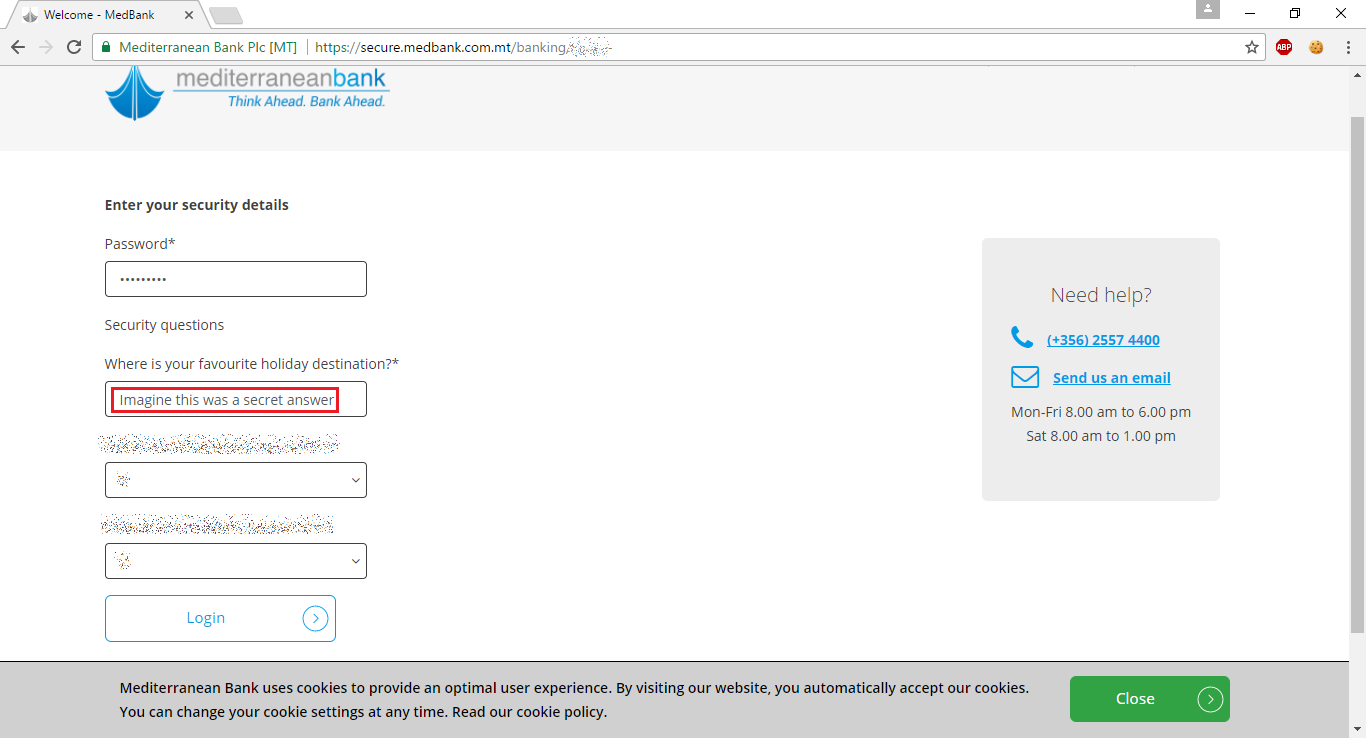
Now, using secret questions is already arguably very stupid in the first place. But not obfuscating the answer (which the old system did properly, by the way), is just terrible from a security standpoint. Security answers, while not passwords in themselves, are password-like material. You do not want someone looking over your shoulder to be able to read them just because you are typing them in.

Moving on to the less serious and more silly flaws, it seems like Mediterranean Bank have taken inspiration from JobsPlus (see the March issue) and put in a language selector with just English in it:

You can choose between English… and English.

What about that cookie policy at the bottom? They ask you to read their cookie policy, but there is no link. It looks like they just forgot to include it, because their main website (i.e. not the online banking part) has it:

Sport Malta: Insecure All The Way

Sport Malta, another website by Cyberspace Solutions Ltd. (a company well-known to this series – see “Lost in Cyberspace in February 2017“), was caught processing credit cards and login insecurely:

It seems like they now have HTTPS, but it doesn’t quite work because of mixed content:
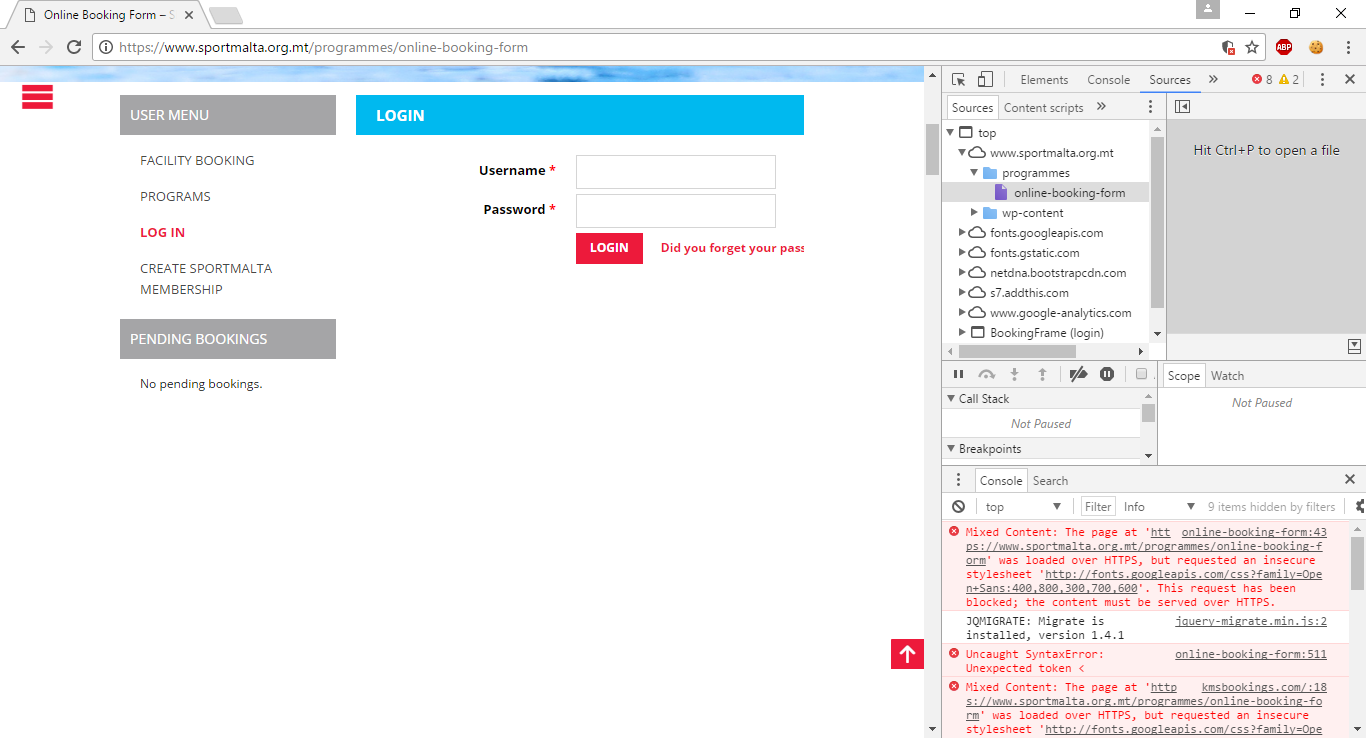
Poor guys. They can’t seem to get one thing right.

EUROPA: Cobwebs and Such

Like Sport Malta, the website of the European Union has a bit of a mixed content issue that invalidates its HTTPS setup:

So like any good citizen would do, I decided to report the issue. In their contact form, you can specify what browser you’re using. Well, the browser versions in the list are ancient (I was using Chrome 58, and the latest one in their list is 40; likewise, although I was using Firefox 53, I could only choose up to Firefox 34. They even managed to misspell the Konqueror web browser.

Anyway, I reported the HTTPS problem, and also asked them nicely to update the browser versions on the contact page. When you write to them, they tell you that it can take about 3 days for them to get back to you.

And that’s exactly what happened. Today, I received a reply, which said:

“Would you kindly clarify if you are referring to some specific webpages?
You may contact us again in any of the 24 EU official languages via our webform which is available here:
https://europa.eu/european-union/contact/write-to-us_en
This clarification would enable us to forward your message to the relevant department of the European Commission for information purposes.”

So basically, having taken 3 days to reply, these guys didn’t even bother to browse their own website’s homepage. And contacting me back through a no-reply email address, they expect me to fill in that form again, just so that I can tell them what they could already have determined themselves, and then forward it to some department where it would then get lost in a bureaucratic hole.

No thanks.

Spotlancer: Insecure Login

Just more of the same from Spotlancer:

TicketArena: Insecure Credit Card & Login

Be careful where you buy your tickets from! Ticket Arena is served over insecure HTTP, yet it processes credit card info:

…and credentials:

“Your credit Card is 100% Safe and Secure,” they said. “We use the latest standards for security with Comodo,” they said.

Image credit: taken from here

Summary

As I’ve repeated ad nauseam over the past articles, you simply cannot process sensitive data (including passwords and credit card details) over an insecure channel. It doesn’t matter if you’re using an HTTPS iframe inside an insecure HTTP-served page. It’s simply not enough.

Websites also need to be tested better. Several websites that we have seen in this article have various problems of different severity levels that could have easily been caught earlier with a little more attention.

We’ll see more issues along these lines in Part 2. In the meantime, I would like to thank all those who sent reports for entries that were included in this article, and I welcome submissions for the June issue.

The Shameful Web of April 2017 (Part 2)

This article is a continuation of The Shameful Web of April 2017 (Part 1) and a part of the Sorry State of the Web series, in which I and various contributors show various blunders in supposedly professionally made websites in order to promote a better web.

The Hive: Mixed Content

At the time of writing this article, The Hive still has an issue with its HTTPS connectivity in that it is considered insecure because it’s using a resource that isn’t coming over HTTPS.

If you want your site to be served over HTTPS, then any images, scripts, and any other resources that it uses must also be served over HTTPS.

Malta Stock Exchange: Content Should Come First

Think of this: if I trade on the stock exchange, I would like to be able to see stock and share prices quickly.

So let’s go to the Malta Stock Exchange website:

(By the way, until a few days ago, there was a nice big photo of Fort St. Angelo instead of this Latest News section. It still gets in the way of finding the information you want, but it looked a lot more silly with a nice picture of the Fort, and I wish I had grabbed a screenshot back then.)

Now, we have to scroll halfway down the page:

Then, we need to expand “Regular Market”…

…and finally, we can see the prices we were looking for. Unfortunately, this is not very intuitive if you’re visiting the site for the first time, and it is a real pain in the ass to have to do this every time you want to check the share/stock prices. This is the information that people want to see most of the time, and it should be the first thing presented on the site, not buried somewhere far down the page.

There is nothing intrinsically ‘wrong’ with this in the sense of many other serious flaws that I usually write about in these articles. However, from a usability point of view, it really sucks.

MTA: Load Times and Insecure Login

The Malta Tourism Authority website is a terrible failure in terms of load time: it usually takes over 20 seconds to load.

As if that wasn’t enough, it offers an insecure login facility, which you’ll know to be a serious Data Protection violation if you’ve read previous articles in this series.

Olimpus Music: Insecure Login

Another offender in the category of insecure logins is Olimpus Music.

Basically, don’t use their online checkout facility until they use an encrypted connection.

Owner’s Best – A Real Mess

In “The Broken Web of March 2017 “, we covered some issues with the Owner’s Best website. I see they still haven’t fixed the “Error : Rows Not Set” bug that you can still see if you scroll to the bottom of the page, and neither did they fix the property detail links scrolling down to the contact form and confusing people as a result.

But there’s more. And worse.

For starters, they have a “Property TV” link in the navigation.

Sounds interesting! Let’s see what it does.

Boom. Dead link.

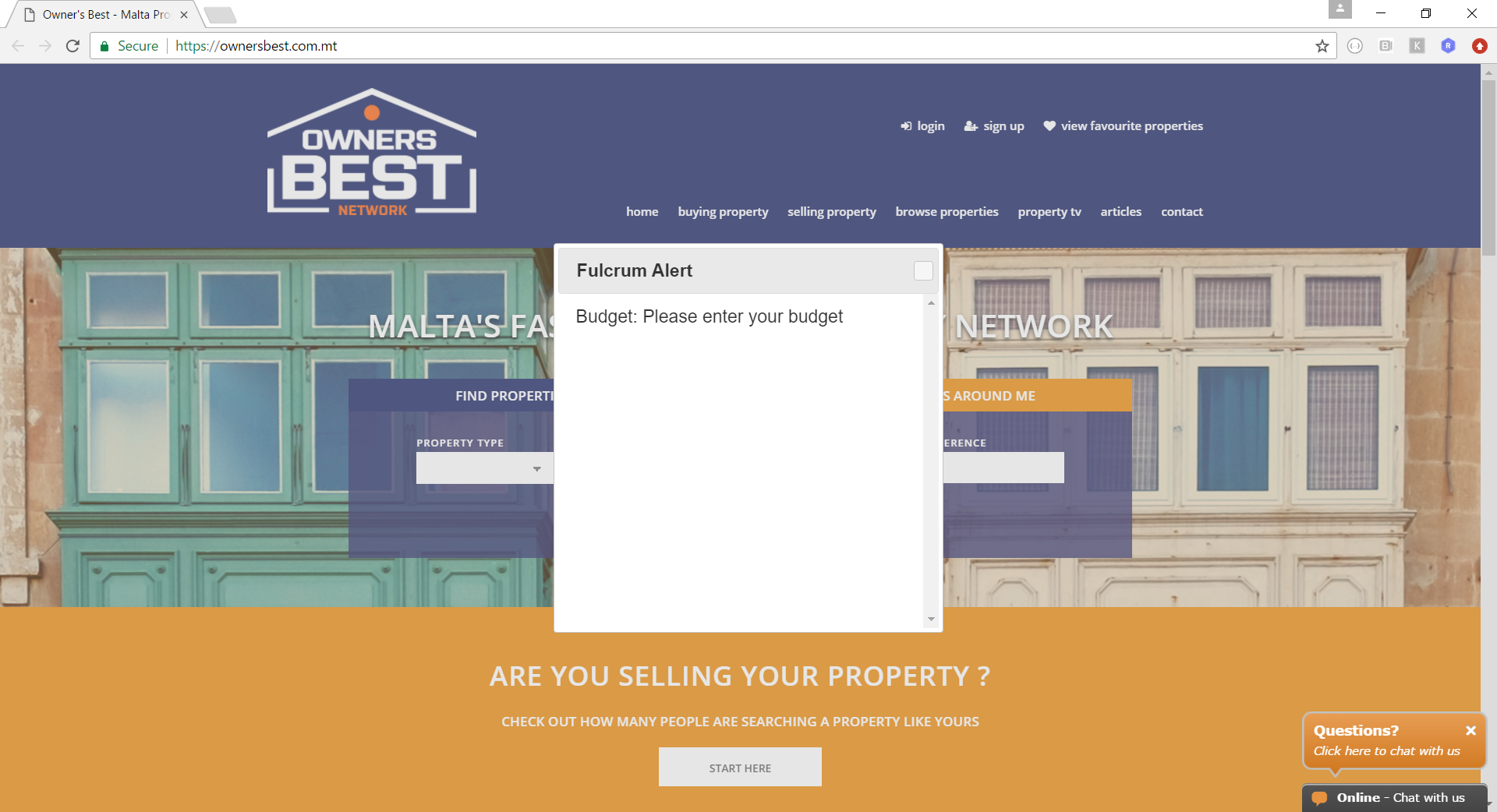
Okay. Let’s try searching for something from the homepage. Oops, I forgot to enter a budget – my bad.

But what the hell is this Fulcrum Alert? And what is wrong with the close buttom? That was a rhetorical question actually. Image 404s in console:

Oh dear. Okay. Let’s put in a budget then.

I put in 10,000. Hey, I’m broke. Obviously, nothing matched, and I got a sad message saying “None properties found”. Yes, you has very good England.

Now I put in a budget of 10 million. That means that I’m super rich, and I’m ready to spend anything up to 10 million on a single property. I got 3 results. Wow. These guys must deal in some real luxury stuff. In fact, two of the results are over budget.

The above search results are based on a 5-million-Euro budget. It gave me this one 4.3-million-Euro bungalow in Dingli. Why didn’t I get this when I searched with 10 million Euros as a budget? 4.3 million is less than 10 million, right?

Now I searched with a budget of 100,000 Euros. Not only do we get all these nice results that would have fitted quite nicely within the several-million-Euro budgets we pretended to have earlier, but we also get properties that are beyond budget, like the one at the top right and the one at the bottom right.

In summary, let’s just say that the search functionality at the Owner’s Best website works in mysterious ways, whether that is intentional or not.

Seasus – Insecure Login

Let’s welcome Seasus among the ranks of the websites that offer an insecure login form:

It is touching to see how much they care about their clients.

Something Different – Various Issues

Let’s take a look at Something Different, a website by Untangled Media (we’ve covered some more of their work in the past).

First, they accept credit card details over an insecure connection. That’s bad. Very bad.

Of course, the credit card iframe itself uses HTTPS, but it’s an HTTPS iframe embeded in an HTTP page, which is still insecure (and illegal – see “The Sorry State of the Web in 2016“), and there is no padlock icon necessary to provide the user with the trust guarantees s/he needs in order to give out his/her sensitive information on the web.

Login is also served insecurely, as you can see above.

We can see another instance of this, as well a lack of a lot of basic validation, in the user registration process:

As you can see above, you can fill in bogus data for most fields. There isn’t even a simple check on the structure of the email address.

In the second step of user registration, you choose a password. Insecurely, of course.

And that’s it! Congratulations for registering your invalid account insecurely!

In this section, we took a look at Something Different. Or rather, more of the same.

Untangled Media / Winit

In Untangled Media‘s Web Publishing section, you’ll find references to various sites including Something Different (see previous section) and something called winit.com.mt:

As they say in the summary, “Everybody loves winning things.” So do I! Let’s follow the link and check out the site.

Oops. Let’s try going to the root of the domain instead.

Win it indeed! It’s more like Untangled Media have lost it.

Summary

April has been a very busy month for spotting issues on websites. We’ve seen a lot of serious security flaws (e.g. insecure login and credit card processing) that have been covered extensively throughout this series.

However, we’ve also spotted a number of issues including high loading times (on one occasion due to the use of large images without thumbnails) and various usability problems. Always keep in mind that websites need to deliver information (whether to sell or otherwise), and thus, information needs to be delivered in a timely, clear, and intuitive manner.

Let’s hope that this article makes some people chuckle, and makes others do a better job of building websites!

Thanks for reading, and stay tuned for the May edition of The Sorry State of the Web! If you find any issue that you would like to include in this series, we would love to hear about it.

The Shameful Web of April 2017 (Part 1)

This article is part of the Sorry State of the Web series, which aims to raise awareness about common and fundamental issues in supposedly professional websites in order to push web developers and designers to raise the bar and deliver at least decent user experience. Since a lot of issues were noted in April 2017, the April issue will be split into two parts. I would like to thank those readers of Gigi Labs who contributed several of the entries in this article.

JobsPlus Receives e-Business Award

In the March 2017 issue of the Sorry State of the Web series, I had pointed out some really basic flaws in the JobsPlus website. That didn’t keep it from receiving an award for “best technology in the e-Government sector”.

Image credit: taken from here

Facebook’s Intrusive Login Prompt

If you view a video on Facebook and you aren’t logged in, you get this login prompt that practically takes up the entire window:

There’s a tiny “Not Now” link at the bottom that you can click. This doesn’t actually remove the prompt, but makes it smaller and moves it to the bottom:

Unfortunately, there seems to be no way to close it, and it still takes up a significant portion of the screen, especially if you are on a laptop. Not very nice!

Don’t Send Passwords via Email

I got this email from a web hosting company:

They never learn. You should never send passwords via email. There is absolutely no guarantee that emails are transmitted via secure channels, so you should assume that it is insecure by default. Instead, let the user choose a password on your website, when the content is served over HTTPS.

Links Should Actually Work

We all know how annoying broken links are, but RightBrain have found a way to match that frustration using links that actually work:

The social media icons at the bottom-right actually point to the website’s homepage, rather than to the social media portrayed by the icons.

It’s not enough that links aren’t broken. Make sure they actually go to the right place!

Microsoft .NET Core Documentation

If you want to learn a little C#‎ (whatever that is supposed to mean), you’re in luck. Microsoft has some tutorials about it:

Seriously though, the .NET Core documentation had some funny HTML entities running around in its sidebar, as you can see above. Very careless, but it looks like they’ve noticed, because this has now been fixed.

Another area where .NET Core documentation is still lacking is in printer-friendliness:

I have written in the past how making webpages printer-friendly is really easy yet very often overlooked. In fact, in the example above, you get around 10 pages of printed content, and the rest of 67 pages which are blank. I have raised this with Microsoft. It seems to be fixed in some browsers (e.g. Edge), and mitigated in Chrome. It’s no longer 67 pages, but at the time of writing this article, you still get quite a few blanks.

Finally, I noticed an issue with their HTTPS. As you can see, you don’t get the padlock indicating that the connection is properly encrypted:

Apparently it’s due to mixed content:

This only happened to me using Firefox on Linux though.

Dear Steve

High up on the list of biggest fails ever in this series is the MySmile dental clinic. There is this contact page with instructions from the dental clinic to a certain “Steve” (presumably from Just Some Coding Ltd, who developed the website) on improvements to make:

Although some pages and links seem to have been renamed, the old “Contact” page shown above is still online!

In any case, Steve didn’t really give a shit, because the map point that he was asked to change still points to the exact same place.

Language Confusion

Unlike JobsPlus, DR Gaming Technology‘s website is really multilingual. In fact, it supports so many languages that one of the language flags actually ended up sitting over the search box:

Despite the language selection, The Latest News box to the right includes many languages at the same time, including English, German and Spanish:

Timely CORS Issue

A friend noted that one of the fonts (Times New Roman) used on the login form of Timely (a web app that I love to hate) looked very out of place.

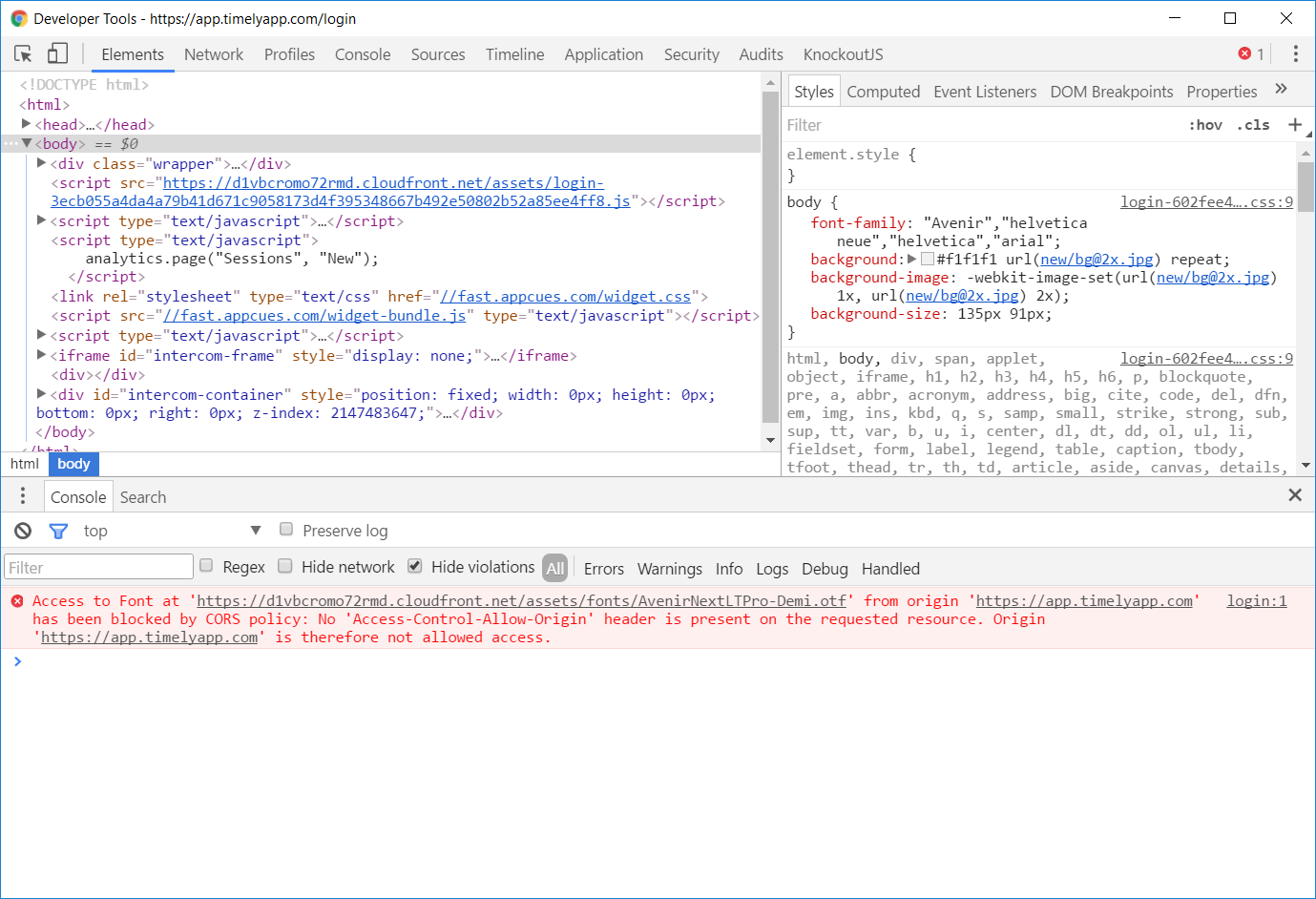
In fact, the developers never intended to use Times New Roman. They wanted a font called Avenir, but the browser defaulted to Times New Roman due to a CORS issue:

Timely fixed this issue within hours, but it wasn’t timely enough to keep me from taking screenshots.

Use Thumbnails

On some articles at Forbes, the images take ages to load. For instance:

What is more depressing than the job ads mentioned in the article? The fact that the image embedded in that page is actually a really large image:

It should be common knowledge now, in 2017, that you should embed a small version of the image (a thumbnail), and link to a larger version. This way, the image won’t impact page loading time, but the people who want to see the detail can opt to do so. This is especially important in galleries with lots of images.

To Be Continued…

More to follow in Part 2.

.NET Core Tools Telemetry

Microsoft may be winning the hearts of developers with their open-sourcey behaviour, but their attitude towards privacy hasn’t changed at all. As if Windows 10 sending usage data to Microsoft wasn’t enough, the .NET Core toolchain does it too.

It’s called Telemetry, and the .NET Core documentation explains the extent of the data that is sent to Microsoft whenever you run a dotnet subcommand.

The problem with .NET Core’s telemetry is not so much the nature of the data that is collected, but the fact that it is done by default, and you have to opt out if you don’t want it. That’s exactly the opposite of how it should be, with many people citing problems of privacy, security, and corporate buy-in in Issue #3093 on GitHub.

The fact that the issue is still open after nearly a year shows that the quest to “improve your experience” (whatever that means) and “provide a great product” is a lot more important than your privacy.

To disable telemetry, you have to add an environment variable called DOTNET_CLI_TELEMETRY_OPTOUT and give it a value of 1. (There are other valid values, such as “true”.) If you follow the instructions and set it in cmd.exe (Windows) or export it in a Terminal window (Linux), as the official documentation suggests, that setting is only valid for the active command line window! Instead, follow the instructions below to set the environment variable permanently.

Opting Out Under Windows

Under Windows, go to Advanced System Settings (via Control Panel or directly from the Start menu) and add it to the environment variables from there.

Opting Out Under Linux

Under Linux, you can permanently set environment variables either by editing the script file for the shell you’re using (e.g. .bashrc for Bash), or else adding an entry in /etc/environment which will apply to all shells as well as non-shell windows:

echo "DOTNET_CLI_TELEMETRY_OPTOUT=1" | sudo tee -a /etc/environment

You will need to restart the system for this change to take effect.

Opting Out Under Mac

I don’t have a Mac, so all I can tell you is to get a decent OS. 😉

Seriously though, the same instructions for Linux should presumably work on a Mac.

Setting up .NET Core on Linux

One of the biggest promises of .NET Core is the long-awaited promise of true cross-platform development. In this article, we’ll see how we can set up .NET Core on some flavours of Linux, and ensure that it works by running a simple console application.

Introduction

In general, if you want to run .NET Core on Linux, you should do the following before even starting development, to make sure it actually works:

  1. Install .NET Core itself.
  2. Create a simple .NET project.
  3. Build and run the application.

The steps to install .NET Core vary depending on the distribution you are using. Different distributions use different package managers (e.g. APT, RPM, YUM, DNF, etc) so you will often need to either add a .NET package source to your package manager’s configuration, or download binaries for .NET Core from Microsoft, before you can proceed to actually install .NET Core.

Microsoft’s Getting Started with .NET Core documentation lists a handful of supported Linux distributions, each with their own installation instructions. Unfortunately, this is not yet updated with the latest versions of several popular distributions. In fact, I have not been able to set up .NET Core in Ubuntu 17.04 (Zesty Zapus), Fedora 25, or CentOS 7. So in this article, we’ll focus on Ubuntu 16.10 (Yakkety Yak) and Linux Mint 18.1.

Unfortunately, these two are both Debian flavours, and both use the Ubuntu package server, so there is not much in the way of variety here.  In any case, let’s proceed with the setup.

Installing .NET Core on Linux Ubuntu 16.10 (Yakkety Yak)

First, we need to follow the installation instructions in the documentation in order to add the .NET package source to APT’s package source configuration:

sudo sh -c 'echo "deb [arch=amd64] https://apt-mo.trafficmanager.net/repos/dotnet-release/ yakkety main" > /etc/apt/sources.list.d/dotnetdev.list'
sudo apt-key adv --keyserver hkp://keyserver.ubuntu.com:80 --recv-keys 417A0893
sudo apt-get update

Here’s what the output of most of this should look like:

With that done, we can install the .NET Core SDK:

sudo apt-get install dotnet-dev-1.0.1

Once the installation is complete, we can create and run a simple project. We can do this without writing any code ourselves, because the dotnet command provides means of generating project templates out of the box.

First, let’s create a directory for our application, and switch to it (note: the documentation provides an alternative way of doing this):

mkdir hello
cd hello

Then, we can create a simple “Hello World” console application in the current directory by running the following command:

dotnet new console

Then, with the following commands, we restore dependencies via NuGet, build the application, and run it:

dotnet restore
dotnet run

Here’s the output, so you can see that it actually worked:

Installing .NET Core on Linux Mint 18.1

The same documentation page with the instructions to install .NET Core on Ubuntu also covers Linux Mint 17. Unfortunately, this doesn’t work for Linux Mint 18. However, you’ll notice that Ubuntu 14.04 and Linux Mint 17 share the same setup instructions. And this Stack Overflow answer shows that Ubuntu 16.04 and Linux Mint 18 also use the same setup. Thus:

sudo sh -c 'echo "deb [arch=amd64] https://apt-mo.trafficmanager.net/repos/dotnet-release/ xenial main" > /etc/apt/sources.list.d/dotnetdev.list'

sudo apt-key adv --keyserver hkp://keyserver.ubuntu.com:80 --recv-keys 417A0893

sudo apt-get update

Then, like before, we install the .NET Core SDK:

sudo apt-get install dotnet-dev-1.0.1

And then, we can actually test this out:

mkdir hello
cd hello
dotnet new console
dotnet restore
dotnet run

We get our “Hello World”, so it works!

Conclusion

We’ve seen how to set up .NET Core on the Ubuntu and Mint distributions of Linux, which are very similar. Different distributions have different setup instructions, and it would be a real pain to cover all of them. The official documentation does provide installation instructions for a handful of popular distributions, but they are slow to update documentation, and do not at this time cover the latest versions.

At least, however, this should be enough to get an idea of what it takes to set things up and run a simple application on Linux using .NET Core.